

AI Governance Research & Commentary
The Sovereignty Trap: "Our Own AI" May Leave Southeast Asia Weaker
Research Fellow, NUS AI Institute
This article was originally published by the Tech for Good Institute
As Southeast Asia’s dependence on external AI systems grows, calls for “sovereign AI” are gaining traction. Yet without a clearer meaning of what sovereignty actually entails, the concept risks hardening into a narrow politics of possession—one that prioritises possession over control. This article examines how ambiguity in AI sovereignty can weaken cooperation and interoperability, and why coordinated resilience is critical for the region.
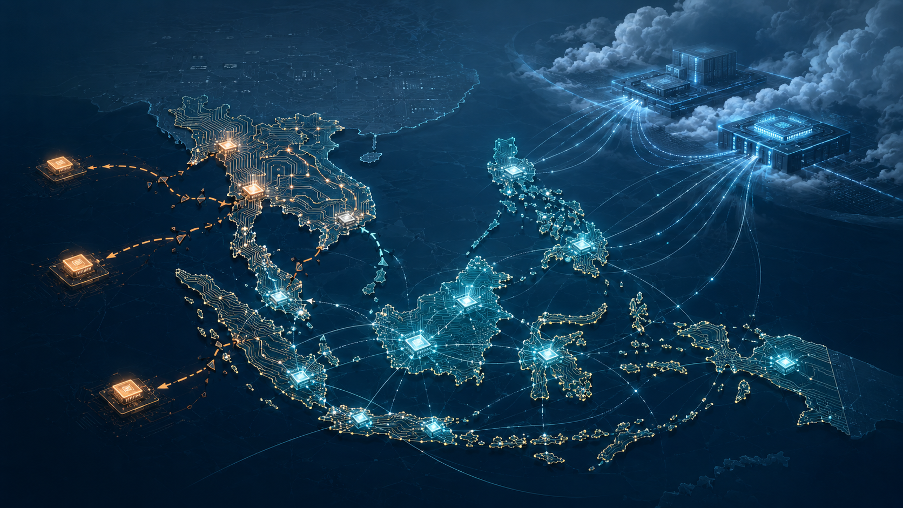
Recent tensions between frontier AI developers and governments have revived an old but increasingly urgent question: who is actually in control of advanced AI systems? Similar concerns have long surrounded digital infrastructure more broadly, particularly as states grapple with shifting geopolitical and economic realities. AI, however, sharpens the issue, as these systems remain emergent, unevenly understood, while also becoming increasingly central to economic strategy, public administration, and national security.
For Southeast Asia, these developments are by no means abstract. The region depends heavily on AI infrastructure, models, and cloud ecosystems developed elsewhere. This includes access to advanced chips and compute, foundation models, and platform ecosystems, whose key rules are often set outside the region. In this context, debates around “AI sovereignty” and “AI independence” have become increasingly central.
The Expanding—and Unclear—Meaning of AI Sovereignty
When it comes to AI sovereignty or AI independence, the issue is not only that power over AI is unevenly distributed. The terminology itself has also become shorthand for several distinct ambitions at once: domestic production, procurement leverage, regulatory capacity, infrastructural control, and strategic autonomy. Treating these ambitions as interchangeable is precisely what gives the term its political potency, while also making it operationally ambiguous.
AI sovereignty therefore remains contested and evolving. Its meaning will likely be shaped less by abstract definitions than by what states actually do in practice. For the purposes of this piece, I use the term provisionally to describe a state’s practical ability to shape the terms on which AI systems are built, procured, deployed, assessed, and governed within its territory. This does not require ownership of every component. AI is not a singular object; its value chain spans chips, cloud infrastructure, data, and model development, as well as procurement, deployment, evaluation, and the legal frameworks governing use.
The risk emerges when sovereignty is reduced to possession rather than understood as control. Given the uneven distribution of compute, capital, infrastructure, and technical capabilities across the AI value chain—and the impracticality of full-stack autonomy even for states with relatively strong capacity—an ill-defined notion of sovereignty can easily devolve into a “politics of possession” centred on “our own model,” “our own stack,” and “our own standards.” For Southeast Asia, the challenge is therefore not to reject AI sovereignty outright, but to resist this narrow, possessive interpretation that conflates national ownership with genuine control, and isolation with resilience.
The Definitional Gap: Why AI Sovereignty Becomes a Catch-All
As mentioned, AI sovereignty is not a single objective. It bundles together a multitude of ambitions, and a state focused on building domestic AI models has different goals from one focused on improving procurement leverage, ensuring public sector reliability, or evaluating externally developed systems.
This distinction matters because the term derives much of its political appeal from its ambiguity. Different stakeholders can project their preferred interpretations onto it: national champions, digital self-reliance, industrial upgrading, cultural protection, or geopolitical hedging. Left undefined, AI sovereignty risks becoming less a concrete governance objective than a floating political slogan—expansive enough to accommodate contradictory ambitions, but too imprecise to guide policy effectively. Once sovereignty is treated as a catch-all aspiration, it shifts from a question of capacity and control to one of fragmented possession.
From Sovereignty to Possession: The Policy Risks
When AI sovereignty is framed too broadly, it risks collapsing into a politics of possession: one in which the value of AI systems lies increasingly in whether they are “ours”, rather than whether they are governable, reliable, affordable, interoperable, or societally useful. Put simply, control over one layer of the AI value chain does not guarantee control over the system as a whole. This is not an argument against national ambition or domestic capacity-building. On the contrary, both can be immensely valuable. However, they only make sense if states are clear about what they are trying to achieve and what kinds of control or leverage such state investments are meant to secure. A nationally branded model may appear sovereign, yet procurement leverage, independent evaluation, and interoperable public systems may in practice offer far greater control.
The problem arises when sovereignty is equated with domestic possession for its own sake—when symbolic independence is prioritised over functional control and durable strategic leverage. Under these conditions, the pursuit of sovereignty can produce familiar distortions: overinvestment in high-visibility prestige projects with limited public value, and underinvestment in less visible but more critical capacities, such as the ability to procure systems effectively, test them independently, stress-test them for failures, establish shared rules, and integrate them into public services.
For Southeast Asia, the stakes are especially high. Most states face structural constraints in compute, capital, infrastructure, and scale. Full-stack national autonomy—meaning national control over infrastructure, data, models, deployment, and governance all at once—is therefore an implausible model. Sovereignty discourse can still encourage the impression, however, that coordination, interoperability, or shared infrastructure are less valuable because they are less visibly “national”. Furthermore, this narrow, possessive idea of sovereignty can breed suspicion toward the very forms of cooperation that would make the region more resilient in practice.
In this sense, AI sovereignty teeters on the edge of performativity: a language of ownership layered over continued structural dependence. For smaller and more dependent states, the danger is not simply that sovereignty remains out of reach, but that its rhetoric distracts from the less visible work that would actually reduce dependence.
From Possession to Coordinated Resilience: A Regional Approach
For Southeast Asia, a more useful understanding of AI sovereignty is not autarky, but coordinated resilience: the ability to participate in AI ecosystems without allowing dependence to harden into subordination. The objective is not to eliminate dependence, but to ensure it does not undermine a state’s capacity to govern. This requires actively shaping the terms of interdependence—diversifying access, preserving strategic flexibility, and reducing the risk that any single external actor can unilaterally dictate how AI is developed and deployed in the region.
Seen in this light, sovereignty is less about owning every layer of the stack than about securing leverage across the layers that matter most:
Strengthen evaluative and regulatory capacity
States need the ability to test, audit, benchmark, and govern the AI systems they use, rather than relying solely on external vendors’ assumptions and claims. This capacity is foundational to meaningful oversight and informed adoption.
Build strategic diversification into AI adoption
Southeast Asian states should avoid deep lock-in in high-stakes workflows where switching providers would be costly, slow, or institutionally disruptive. Diversification across providers, tools, and systems helps preserve policy and operational flexibility. Procurement practices, standards, and interoperability are not technical afterthoughts; they are central instruments for preserving optionality and ensuring that AI systems remain governable across different contexts.
Pursue resilience through regional coordination
Coordinated resilience cannot be built by individual states acting alone. Southeast Asia does not become less dependent by fragmenting into isolated national projects, each too small to exercise real leverage. Instead, it becomes less dependent by pooling capacity around evaluation, talent development, procurement standards, and the minimum conditions for shared resilience. This does not require perfect regional unity or identical priorities, but it does require greater selectivity and alignment in domestic capacity-building efforts.
Prioritise fit-for-purpose national investments
Not every state needs a frontier model, nor would this necessarily be the most efficient use of limited resources. More strategic investments often lie elsewhere: in public-interest applications, local adaptation, multilingual systems, evaluation capacity, and the institutional ability to integrate AI effectively into public services. Sustainability considerations are also critical. Compute access, financing, energy infrastructure, and long-term maintenance all determine whether capabilities are durable, scalable, and ultimately sovereign in any meaningful sense.
Conclusion
The debate over AI sovereignty is not going away. For Southeast Asia, its value will depend on whether the concept is clarified and disciplined. Left vague, it risks collapsing into an “ours, ours, ours” politics that flatters national ambition while weakening collective resilience. The real question is whether Southeast Asian states can still govern effectively when the AI systems they rely on are built, owned, and conditionally supplied elsewhere.
Related Articles





- Home
- The Sovereignty Trap: “Our Own AI” May Leave Southeast Asia Weaker
NUS Artificial Intelligence Institute
- +65 6516 2146
- naii@nus.edu.sg
-
COM3 #B1-08, 11 Research Link
Singapore 119391